The Register
Inspect a system’s class, test findings, conditions and reliance limits in one place.
Open the RegisterThis page is the app. You are already in Plimsoll. A demonstration of a visible limit for banking AI. Not a score for intelligence. A line. Like the mark on a ship’s hull. This far. In these conditions. And no further. There is nothing to log into. Choose a task. The dark panel then states the limit, and where a person still has to take over. See the limit. Own the decision.
This page is the app · A demonstration
You are already in Plimsoll. It shows how far a bank may rely on one AI system for a chosen task.
There is nothing to log into or submit. Choose a task below. The dark panel then states the limit — and where a person still has to take over.
Start here. The four buttons are tasks. Click one. The dark panel is the answer for that task.

The system may recommend. A person confirms before any action is taken.
AI recommends. A person checks the recommendation before it becomes an action.
Illustrative workflow · not an accuracy scoreBank-funded. Built for those who rely on it.
Vendor-independent. Evidence before influence.
Continuously tested. Change must earn its place.
The Register / evidence you can inspect
One AI system can be ready for one task and unsuitable for another. The Register makes that boundary explicit.


Above: the mark. Below: the proof.
The proposed survey connects four things that belong together: access, performance, permitted reliance, and change.
State what could be examined and what was withheld.
Assign the highest reliance the evidence supports for each condition.
Re-test releases and show when class or operating limits change.
One connected assurance model
Your bank keeps the decision. Plimsoll proposes the common reference.
Inspect a system’s class, test findings, conditions and reliance limits in one place.
Open the RegisterReview how the surveyed system fits your bank’s configuration, data and controls.
Explore the proposed serviceRe-test releases and identify changes that affect class or move the load line.
See how re-testing worksIndependence, by design
The proposed model excludes funding from the vendors being surveyed. One bank, one vote. Findings and the vendor’s reply appear together.
Read the independence principlesThe same argument, four ways
This is still the app. The media room holds the film, the podcast, four pictures, and the slide deck.
From possibility to evidence
A business concept by Richard Leclezio.
Illustrative systems. Proposed services. This page is the demonstration.
The media room
A film to sit with. A voice to follow. Four pictures to read whole. Thirty plates you can turn.
A film by Richard Leclezio. Open it on YouTube.
The Plimsoll Line for Banking AI. Twenty-one minutes on a visible limit for reliance, not a score for intelligence.

Plays in this page. An explanatory recording, not a live survey.
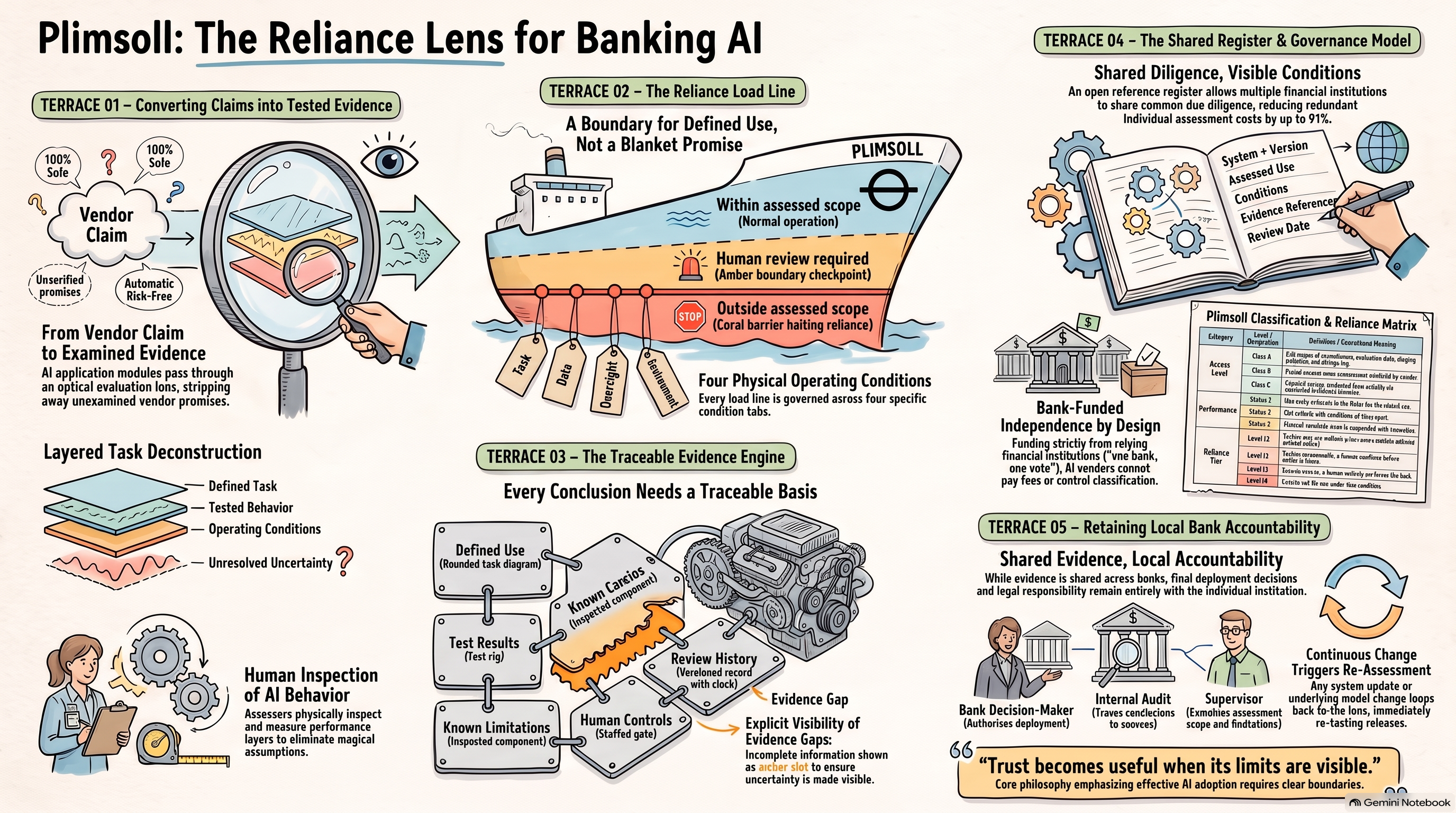
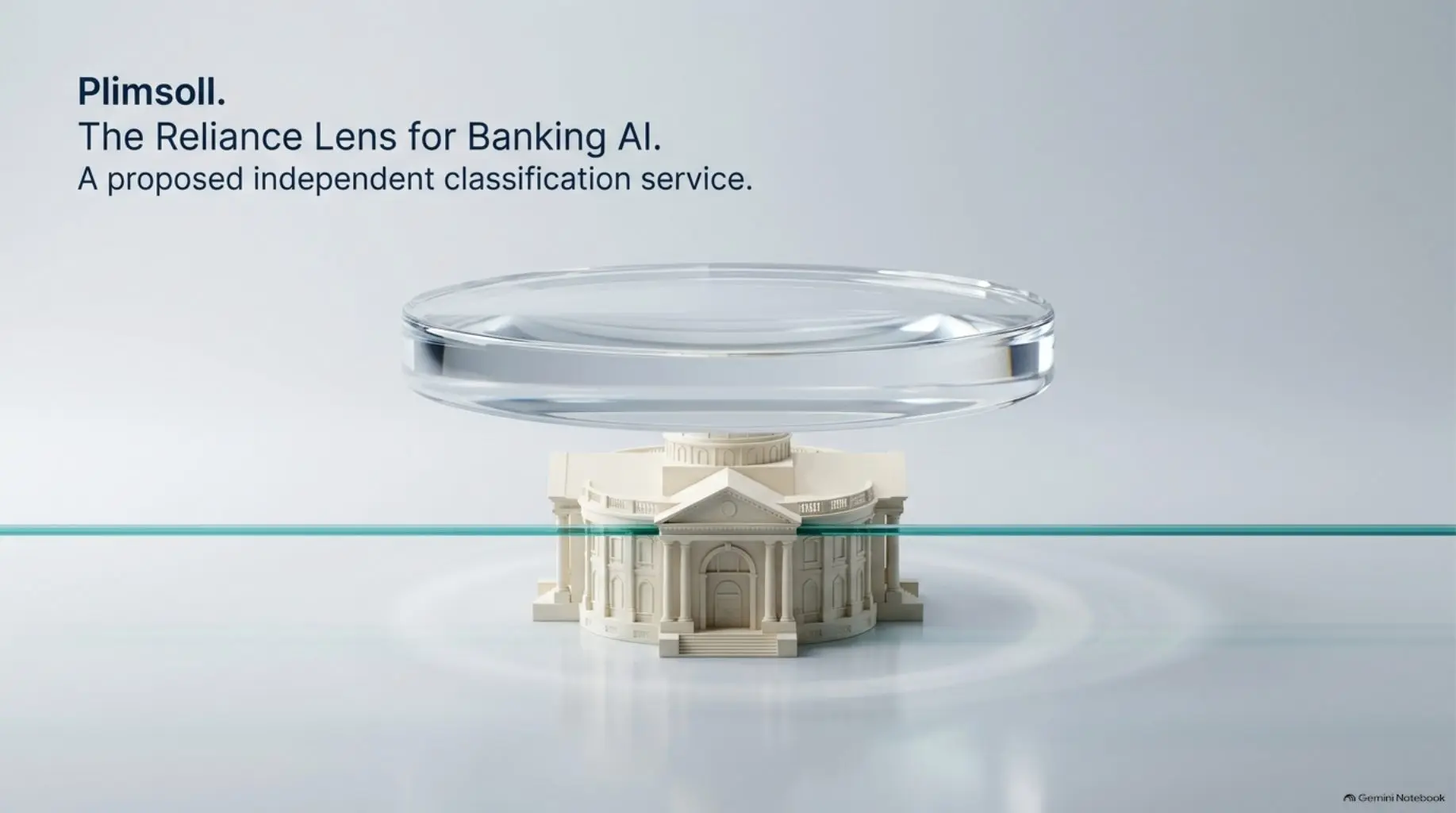
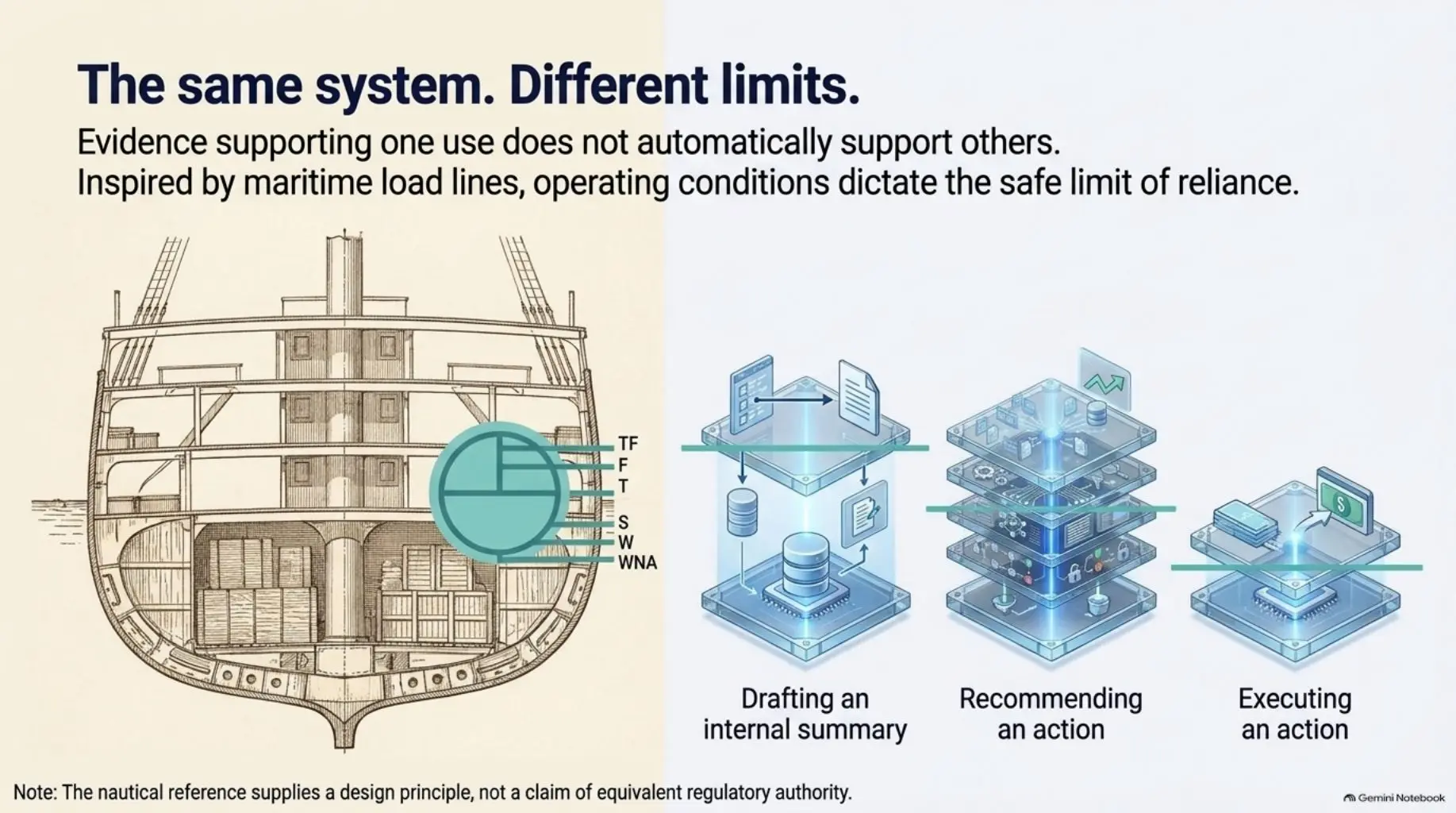
One picture at a time, uncropped. The drawings are concept illustrations. The words painted on them are not live findings.
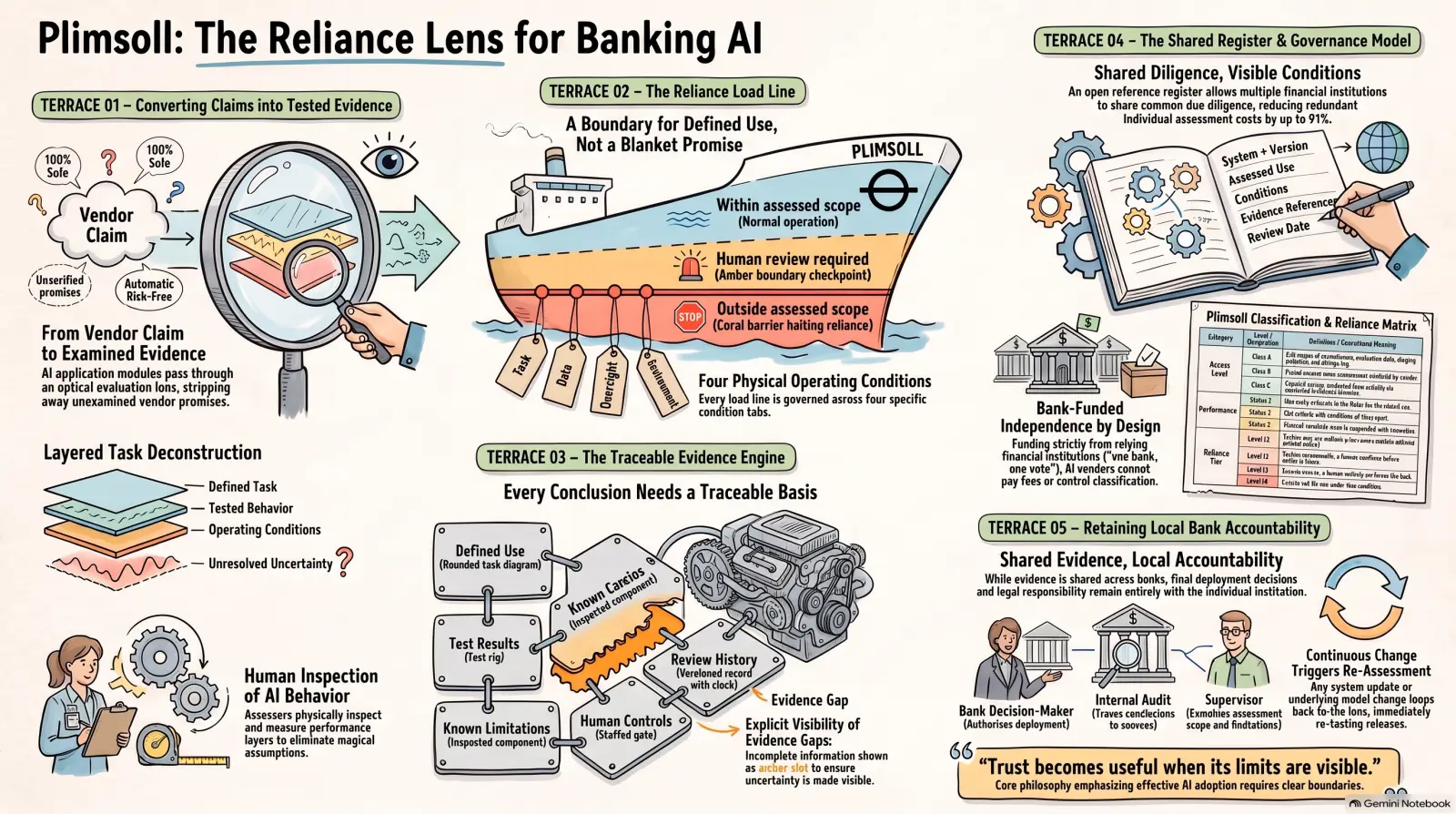
A defined use, a visible boundary, and a register that more than one bank can read.
Thirty slides. Drag, use the arrows, or choose a plate from the strip. The left and right keys work when the stage is selected.
A concept deck. It is not a live assurance report.
01 / THE RELIANCE LANDSCAPE
Trust is specific to the task. Explore how the permitted level of reliance changes across four operating conditions.
Domestic retail accounts, within the surveyed scope.
Height represents the permitted reliance tier—not accuracy or confidence. Names and results are fictional.Read the evidence record ↗
THE REGISTER / SPECIMEN EDITION
Explore nine illustrative records. Select a system to see what was tested, what remains uncertain, and where reliance should stop.
Select a row to open its evidence record. All names and results are fictional.
| No. | System and surveyed use | Class | Status |
|---|
Specimen entries. Vendor names, product names and results are invented. January 2027 is the proposed launch date.
THE SURVEY METHOD / PROPOSED
Three or more subscribing banks name a system and the use they have in mind. One bank, one vote, whatever its size.
The vendor provides documentation, a staging endpoint and release notes. If it declines, we survey from outside, and the entry says so.
A harness built for that banking use: task corpora with ground truth set by practitioners, stress and injection tests, change-control checks.
For each operating condition, the highest reliance the evidence supports. Where we did not test, the mark reads not for use.
Class, load line, findings, and the vendor's unedited reply of up to 300 words. Subscribers get the full survey file.
Re-tested on every release, reviewed each quarter against pooled outcomes, fully re-surveyed if the underlying model changes.
WHO PAYS / WHO DECIDES
The institutions relying on the work fund it. The companies being assessed do not. That separation is the foundation of the proposed model.
Banks and other regulated institutions that rely on the Register.
Vendors, model developers and their controlling investors. No fees, no sponsorship, no equity.
The proposed structure is a Delaware public benefit corporation. The founding charter would prohibit funding from surveyed parties, with the enforceability and amendment protections reviewed by counsel.
The Rules are free to read and change only after a public comment window. Vendors may comment. Subscribers and independent technical members vote.
Every class decision publishes what was tested and what was not, beside the vendor's unedited reply.
The survey queue follows subscriber nominations counted equally, so the largest fee cannot steer it.
Surveyors may not join a vendor they have surveyed for twelve months, and rotate off a system after three years.
Classification began this way. In 1760 the customers of Edward Lloyd's coffee house, the merchants and underwriters who needed to know which ships were sound, formed a society to survey them. Subscriptions to its Register Book paid the surveyors. Owner-pays came later. We are going back to the original arrangement.
MEMBERSHIP / PROPOSED COMMERCIAL TERMS
A shared Register for model risk, third-party risk, compliance, audit and the business. Pricing follows total bank assets.
$10–30bn in assets
$95,000/ year
A common evidence base for a growing AI portfolio.
$30–100bn in assets
$190,000/ year
Shared assurance across teams, systems and use cases.
Over $100bn in assets
$380,000/ year
Institution-wide access for complex AI estates.
Every Register entry and its survey file. The Watch on systems you rely on. Two annual nominations. A vote at the Rules review. Unlimited readers.
Your use, configuration, data and controls checked against the load line. Proposed delivery in three weeks, with an included refresh if the line moves within the year.
The proposed founding programme gives early members a role in the first Rules and the first survey queue. Target opening: January 2027.
FOUNDER’S FILE / THE THESIS
Three regulatory developments inform the proposed business. The opportunity is a founder’s hypothesis, not a regulatory endorsement.
The agencies issued revised model-risk guidance that supersedes SR 11-7. Generative and agentic AI are outside its scope. That exclusion does not remove banks’ wider risk-management responsibilities.
OCC Bulletin 2026-13; Federal Reserve SR 26-2The Fed’s Vice Chair for Supervision discussed how existing risk frameworks apply to AI and the challenges of third-party tools. Plimsoll’s proposed response is shared, use-specific evidence for the relying banks.
Bowman, remarks to the FSOC roundtable on AIOSFI’s revised E-23 guideline takes effect on 1 May 2027. Its enterprise-wide, risk-based approach includes AI and third-party models at federally regulated financial institutions. This date informs the proposed launch plan.
OSFI Guideline E-23 (2027)A bank can obtain a certificate that a vendor runs a tidy management system, and another that the vendor's agent passed a battery of adversarial tests. The vendor buys both, picks the assessor and sets the scope. Neither says how the system performs on the bank's actual task, or where reliance should stop. So each bank works that out alone, from outside, with whatever the vendor chooses to show one customer.
When supervisors stop prescribing, the burden of proof moves to the bank's own judgment, and judgment wants a reference point that boards, auditors and examiners all recognize. Shipping solved this in 1760 with a private body that surveys once for everyone who relies on the result. The bet is that banking will buy the same thing for AI, and that whoever writes credible Rules first will shape what sound practice comes to mean.
FOUNDER’S FILE / THE LANDSCAPE
| What a bank can get today | What it examines | Who pays | Who sets the scope | Sees results in production | Written for a banking use |
|---|---|---|---|---|---|
| SOC 2 report | The vendor's security and availability controls | Vendor | Vendor | No | No |
| ISO/IEC 42001 | The vendor's AI management system | Vendor | Vendor | No | No |
| AIUC-1 | An agent's behavior under adversarial and operational tests, re-run quarterly | Vendor | Vendor picks the agent and the auditor | No | No |
| Shared vendor-risk utilities | Control questionnaires and evidence, pooled across banks | Banks | A standard questionnaire | No | Financial services, controls only |
| The bank's own review | Whatever the vendor will show one customer | The bank | The bank | Its own only | Yes |
| Plimsoll | The system's performance and limits in a named banking use | Relying banks | Subscriber votes and public Rules | Pooled across subscribers | Yes |
A surveyor treats all of these as inputs, and reads a vendor's SOC 2 report, ISO/IEC 42001 certificate and AIUC-1 results the way a ship surveyor reads type approvals: gladly, before testing the thing itself. Independent commentary on the newest of them makes the same point about who chooses scope and auditor.
Banks have paid to share this kind of work before. TruSight, founded in 2017 by American Express, Bank of America, JPMorgan and Wells Fargo to pool vendor control assessments, was bought by S&P Global in 2023. Its focus on shared control assessments is a useful precedent for the proposed performance-survey model. The 2023 interagency third-party guidance already lets banks lean on shared utilities for due diligence while keeping responsibility for the outcome.
FOUNDER’S FILE / SHARED ECONOMICS
A bank assessing one vendor AI system by itself spends about $79,000 of second-line time and sees only what the vendor shows a single customer. Plimsoll spends about $137,000 in the first year on the same system, sees far more, and divides the bill.
What the bank pays is a different number, and the gap between the two is the margin. A $50 billion bank relying on 25 entries pays $190,000 for the Register, about $7,600 an entry, plus $22,000 for each Overlay. That is roughly $30,000 per system in use against $79,000 alone.
Assumptions. Alone: two people for six weeks at a loaded $165 an hour. Plimsoll: a surveyor at $270,000 loaded completes 3.5 new surveys a year and keeps 12 in class; $30,000 of test infrastructure and practitioner time per new survey; $600 a month to re-test. These are illustrative operating assumptions.
FOUNDER’S FILE / FINANCIAL MODEL
Explore the proposed business over sixty months. Change acquisition, usage or price to see revenue, cash and staffing respond. All figures are planning assumptions.
Month 1 is January 2027. Founding members prepay 24 months at 25% below list; everyone else pays a year in advance; 6% of contracts are lost at each renewal in the base case. Surveyors and Overlay analysts are hired as volume requires; the other teams follow a plan. Tax and interest are left out. Funding is fixed at a $4.5 million seed and a $9 million Series A in month 15, so the cash line shows what each case does to the same money.
FOUNDER’S FILE / THE MARKET
About 160 US banking organizations hold more than $10 billion in assets. At list price and ten Overlays a year, they are worth some $64 million a year. Add Canadian, British and European banks of the same size, insurers and the largest credit unions, and the reachable market is about $146 million.
| US banking organizations by total assets | Count | Register, list | Register value a year |
|---|---|---|---|
| Over $100 billion | 35 | $380,000 | $13.3m |
| $30 to $100 billion | 40 | $190,000 | $7.6m |
| $10 to $30 billion (estimate) | 85 | $95,000 | $8.1m |
| Overlays, ten a year each at $22,000 | 160 | $35.2m | |
| US banks over $10 billion | 160 | $64.2m |
That is small for a venture fund and large for a business with 65% gross margins, contracts paid in advance and no competitor able to match its independence. The base case takes 17% of it by 2031. What grows is the number of vendor AI systems inside each bank, and every one of them needs an Overlay.
Counts over $30 billion are from FFIEC holding-company data at 31 March 2026, plus three large banks without a holding company. The $10 to $30 billion count and all adjacent pools are estimates and require validation before investment decisions. The FDIC reported 4,238 insured institutions at 30 June 2026.
FOUNDER’S FILE / GO TO MARKET
Begin with institutions preparing for OSFI E-23 on 1 May 2027. Validate demand, buying authority and applicable group requirements through discovery conversations.
Heads of model risk and third-party risk at the six large Canadian banks and a dozen US regionals between $50 and $250 billion. One question: which five vendor AI systems are you being asked to approve this year? The overlap between their answers is the first survey queue, and the proof that the survey can be shared.
Eight founding seats, from $142,500 to $570,000 for 24 months depending on size, paid up front. Small against a second-line budget. The seat on the Rules Committee is what a head of model risk actually wants: a say in what good looks like before somebody else decides.
Ten systems in year one, chosen by the founders' votes. Expect financial-crime investigation agents and contact-center agents to lead, because that is where banks are deploying first.
Each founding member adds one paragraph to its next vendor agreement. Once twenty banks have it, access stops being a favor.
Submit Rules 1.0 in answer to the agencies' request for information when it is issued, and brief OSFI before E-23 takes effect. Ask for nothing. Be the reference that others cite.
The chief risk officer signs. The heads of model risk and third-party risk champion it because it takes work off their desks. The chief AI officer wants it because approvals stop being the bottleneck. Procurement resists the clause until the second vendor accepts it.
FOUNDER’S FILE / THE SURVEY CLAUSE
Ships are classed because charter parties and hull insurance policies say they must be. The equivalent here is a clause in the bank's vendor agreement.
Supplier agrees that Customer may appoint an independent classification body to survey the System's performance and limits of use, and will give that body reasonable access to documentation, a staging endpoint and release notes for that purpose. Supplier will notify the body of any material change to the System, including any change of underlying model, before release. Customer may share the body's findings with other financial institutions that rely on the same survey. Supplier may not pay the body, and may publish a reply of up to 300 words alongside any finding.
A draft to take to counsel. It is not legal advice.
Every subscriber returns production results for the systems it uses. Drift that no single bank could see shows up across twenty. The proposed advantage is pooled outcomes across relying banks.
The second AML investigation agent costs a fraction of the first to survey. By year three the library of harnesses is the cost advantage.
Audit firms, certification bodies and ratings businesses all take money from the companies they assess. They would have to give that up to match this.
FOUNDER’S FILE / RISKS & STOP RULES
| Risk | Why it might happen | What we do about it | Stop or reshape if |
|---|---|---|---|
| Banks will not fund a shared good | Everyone benefits from a public mark, so everyone waits for someone else to pay. | Class status is public. The evidence, the load line detail and the Watch are for subscribers only. | Fewer than four founding members by day 90, or fewer than eight subscribers by month 9. |
| Vendors refuse access | Fear for intellectual property, and contract terms that forbid benchmarking. | The Survey Clause, surveys from outside through members' licensed instances, and a printed right of reply. | Under half of nominated vendors give access by month 12 and outside surveys cannot get beyond class C. |
| Supervisors prescribe, or bless another scheme | The request for information ends in detailed rules or a named standard. | File the Rules in that record. Map to whatever is issued. Accept other schemes' evidence as inputs. | A mandated scheme makes private class redundant. Then become a surveyor under it. |
| A classed system fails badly at a member | It will happen. Every assurer meets this eventually. | Class states limits and is not a warranty. The load line is on the record. Indemnity cover, contractual caps, a published review after every incident. | Two failures inside a stated load line in 24 months that the tests should have caught. Halt new surveys and rebuild the method. |
| Systems change faster than surveys | Weekly releases, and silent swaps of the underlying model. | Automated re-tests on every release. Class lapses after 90 days without one. Swaps trigger a full re-survey. | Median time from a vendor release to a re-test exceeds ten working days for two quarters. |
| A bigger firm copies it | The audit networks, a ratings business or a certification body decides to enter. | They are paid by vendors elsewhere. The Survey Clause and pooled outcomes compound with every member. | A credible bank-funded rival signs five of the ten largest banks first. Then merge or sell. |
FOUNDER’S FILE / FIRST 90 DAYS
Week 1 begins Monday 28 September 2026. January 2027 is the proposed opening date, subject to the launch gates below.
Ten banks have named their systems and at least five systems appear on more than one list. If they do not overlap, the shared-survey premise is wrong for AI. Stop.
Two vendors have agreed access and Rules 0.1 has drawn written comments from five banks. If vendors refuse, run both pilots from outside and price the difference.
Four founding members signed, two entries in the Register, seed committed. With fewer than four signatures, do not raise. Reshape or stop.
FOUNDER’S FILE / TEAM & CAPITAL
Founder and chief executive: Richard Leclezio. A career in financial-services change and governance across Deutsche Bank, Credit Suisse, Citi and Mizuho. Year one is the Rules, the founding members and the supervisors. The buyers are the people he has spent two decades working beside.
Has validated machine-learning models inside a large bank and built evaluation harnesses for language models. Owns the method and every class decision.
Bank regulatory counsel, ideally with time at an agency. Owns the charter covenants, the Survey Clause and liability.
Financial-crime operations, consumer compliance, and credit. They set the ground truth the harnesses are scored against.
Harness, Register and Watch. Simple for members to read, reproducible underneath.
A former head of model risk or third-party risk who has bought this kind of thing and knows how it gets approved.
Twelve people at the end of 2027. Fifty-two at the end of 2031 in the base case, more than half of them surveyors and analysts.
No investment from any company Plimsoll may survey, from model developers, or from their controlling investors. Bank investors are welcome, capped at 9.9% each and 25% together, without board control. A members' trust holds a veto over any change to the independence covenants.
Where it ends: ratings and benchmark businesses buy assets like this, as S&P Global did with TruSight. Classification societies already sell assurance and may want a banking arm. Or nobody buys it. The base case throws off cash from 2030, and a utility owned partly by its members is a respectable place to stop.
FOUNDER’S FILE / THE NAME & MARK
Samuel Plimsoll was the member of Parliament who fought for a mark on the side of every British merchant ship showing how deep it could safely be loaded. The Merchant Shipping Act of 1876 made the mark compulsory. His line did not make ships safe. It made overloading visible to anyone standing on the quay.
That is the product: a plain mark of how far a system may be relied on, that anyone can read. The disc and line are the historical mark. The letters either side name the body that assigned it. The ladder gives the limit for each condition, from tropical fresh water to winter in the North Atlantic. Ours reads from L3 to L0.
Libre Caslon, for the book. Caslon's types set most of what London printed in the 1760s.
Archivo at its narrowest width, for anything painted on steel: class, levels, figures.
Working name. No trademark clearance has been done.
FOUNDER’S FILE / SOURCES & ASSUMPTIONS
The research references below support the original business thesis; confirm their current application before relying on them. Every price, volume, cost and date about Plimsoll itself is an assumption, and should be validated before launch.
 04 / DeckThirty plates